Native IP multicast delivery for live streaming — using TreeDN, MAHP, and MoQ to reach audiences at a fraction of unicast cost.
MAHP uses FLUTE/ROUTE to multicast CMAF DASH/HLS content and HTTP objects — compatible with DVB-mABR, ATSC 3.0, and 5G MBS. Your players, downloaders, and updaters work unchanged.
 Broadcast Delivery
MAHP uses FLUTE/ROUTE to multicast HTTP objects over IP multicast, serving content from a local cache via a transparent reverse proxy. The protocol is compatible with DVB-mABR, ATSC 3.0, and 5G MBS standards. Clients — whether video players, download managers, or application updaters — connect to a standard HTTP endpoint, completely unaware that multicast is delivering the bytes underneath.
In streaming mode, any encoder that outputs CMAF segments with DASH or HLS manifest playout can feed the MAHP Sender. Unmodified DASH/HLS players work out of the box — no plugins, no SDK, no player-side changes required.
Beyond video, MAHP accelerates bulk distribution of any HTTP object — AI model weights, video game patches, OS updates, and CDN cache fill. One multicast transmission replaces thousands of parallel unicast downloads.
Forward Error Correction recovers from packet loss without retransmission. When FEC alone isn't enough, MAHP repairs via multicast repair streams or unicast HTTP repair from upstream nodes — automatically selecting the most efficient path.
Streaming: Your CMAF encoder feeds the MAHP Sender, which uses FLUTE/ROUTE (DVB-mABR, ATSC 3.0 & 5G MBS compatible) to multicast DASH/HLS segments via PIM-SSM, over-the-air broadcast, or AMT tunnel. The MAHP Receiver serves content from a local HTTP cache — your unmodified players work out of the box.
File & cache fill: Your origin serves any HTTP object. The MAHP Sender uses FLUTE/ROUTE to multicast once via PIM-SSM, OTA, or AMT. The MAHP Receiver serves from its local cache — your existing applications download via standard HTTP.
Observability
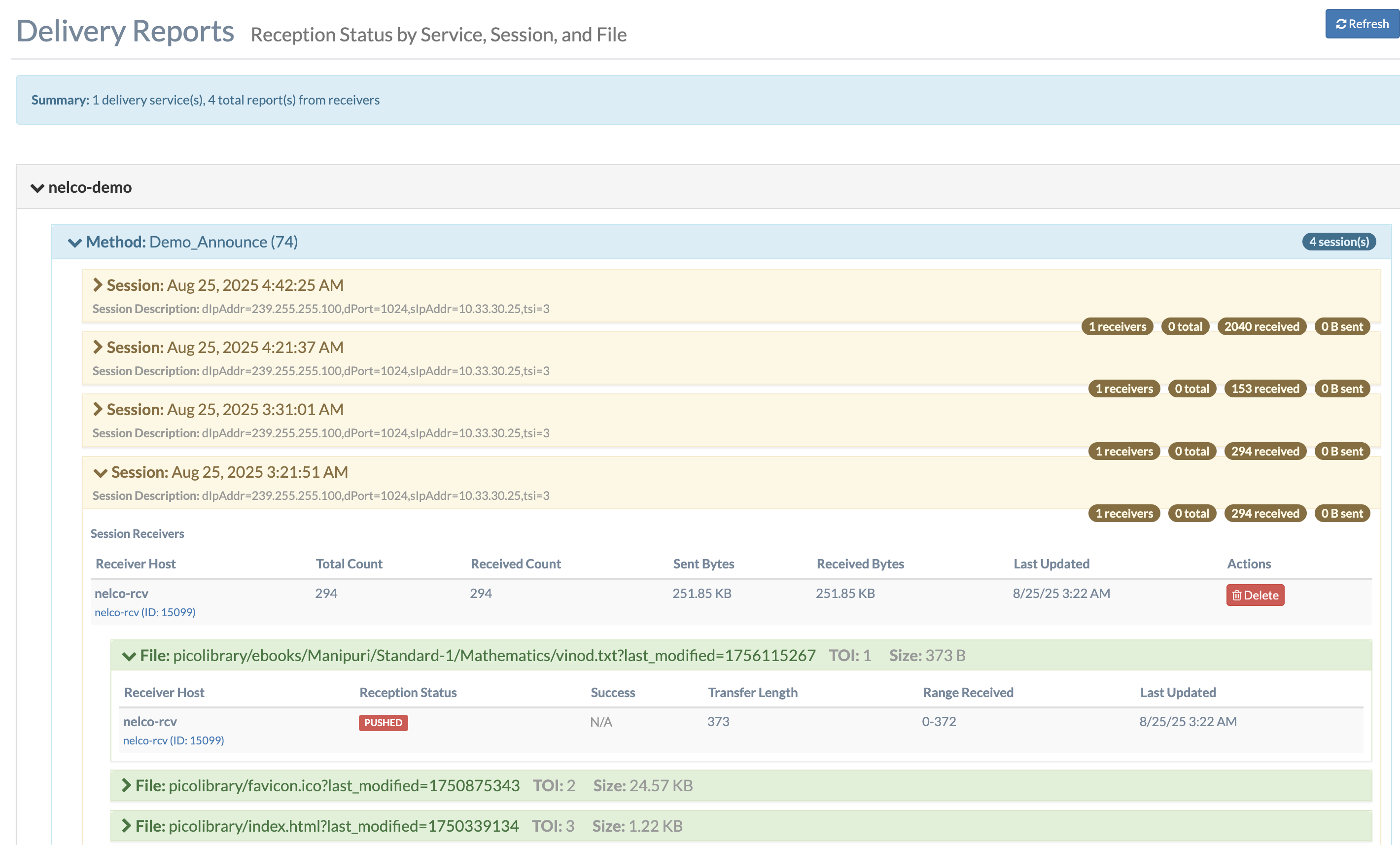
MAHP tracks every multicast session end-to-end. Receivers report delivery status per file and per session — including bytes sent, bytes received, reception status, and repair activity. When packets are lost, MAHP automatically repairs via multicast FEC first, then multicast repair or unicast HTTP repair from upstream nodes. Session reports give full visibility into delivery quality across all receivers.
 Infrastructure
TreeDN is built on PIM-SSM — a network-layer multicast routing protocol independent of any application or transport. The same distribution tree carries MAHP, MoQ, or any future multicast stream type without changes to the network. Replication happens in ISP router silicon at each hop, eliminating the energy cost and capital expense of software-based fan-out.
Expanding the Blockcast multicast footprint is a configuration change, not a hardware deployment. Enable AMT on existing ISP routers to add hardware relay capacity — each device supports up to 500,000 concurrent tunnels at line-rate throughput up to 1 Tbps. Where hardware isn't available, deploy kernel-based software relays that handle replication at near line-rate using kernel bypass and zero-copy forwarding.
Tier 1 — Carrier-grade: ISP-deployed
hardware relays with SLA-backed anycast infrastructure.
Tier 2 — Datacenter: Professionally
hosted software relays and edge caches.
Tier 3 — Community edge: BEACON nodes
extending coverage to homes, venues, and mobile devices.
Traditional unicast CDN delivery scales linearly — 1 million viewers at 5 Mbps consumes 5 Tbps of backbone bandwidth. With TreeDN, a single stream is replicated at each relay hop, reducing backbone bandwidth by orders of magnitude. Multicast delivery approaches a fixed cost per stream regardless of audience size.
Blockcast’s DePIN model incentivizes operators to deploy relay capacity where demand emerges. BEACON node operators earn rewards for contributing bandwidth and coverage — turning rollout from a capital planning exercise into an organic, demand-driven expansion that reaches underserved regions faster than traditional infrastructure builds.
Automatic fallback from multicast to unicast within the same session. Players see no interruption — the cache continues serving regardless of transport source.
Every multicast packet is cryptographically signed, preventing injection of forged content into the delivery stream — verified at each node in the distribution tree.
DNS-based relay discovery finds the topologically nearest AMT relay automatically. No separate signaling infrastructure needed — discovery is built into the delivery path.
MAHP works as a transparent HTTP proxy. Your existing DASH/HLS players, download managers, and application updaters require zero modifications.

.png)
