Native IP multicast delivery for live streaming — using TreeDN, MAHP, and MoQ to reach audiences at a fraction of unicast cost.
MoQCAST provides sub-500ms glass-to-glass latency for live sports, esports, and interactive events — all delivered over existing infrastructure. It plays natively with client-side players, browsers and ATSC 3.0 players. For operators, there’s no new equipment to purchase. For content providers, there’s no more duplicative bits to deliver.
 Multicast Streaming
 MoQCAST leverages Media-over-QUIC (MoQ) and TreeDN to enable multicast over the internet without any of the baggage. With just a Chromium extension (for browser playback) or an SDK (for client-side players), you can spread your multicast signal around the globe via the Blockcast RELAY. No more specialized multicast operator equipment needed. Deliver streaming video over multicast to TVs (via ATSC), mobile devices, and web browsers.
Whether viewers are watching through a web browser, their phone, or a TV, your content reaches them without you having to do anything extra. By placing a MoQCAST Packager downstream from your live encoder, you can package everything into MPEG Media Transport (MMT) and deliver via the Blockcast RELAY to MoQCAST-enabled players. You can also signal to multicast receivers for parallel OTA delivery to ATSC 3.0 TVs and MBS-capable mobile devices.
With MoQCAST, you get the benefits of broadcast (multicast) with streaming economics. That’s because MoQCAST is deployed via the Blockcast MAHP, a software-based reverse proxy which can be deployed on common, off-the-shelf hardware in containers or standalone servers. You get geographic redundancy by leveraging existing cloud providers (or your own datacenters) without the hardware footprint of traditional unicast delivery.
Single encode, three delivery paths: Your content feeds into the MoQCAST Packager (built on FFmpeg), which packages to MMT. The Blockcast RELAY delivers via two paths: the MoQ Relay (QUIC, < 500ms) and the AMT Relay / TreeDN (PIM-SSM multicast over the internet). A parallel over-the-air path reaches ATSC 3.0 TVs and 5G MBS devices directly. The player auto-selects the best available transport.
How It Works Place a MoQCAST Packager downstream from your current live encoding infrastructure to package your streaming content into an MPEG Media Transport (MMT) stream. Built on the industry-standard FFmpeg, it simply repackages your stream into MMT for multicast transport. Nothing else in your workflow needs to change.
Once you have an MMT container, MoQCAST distributes it via the Blockcast RELAY (MoQ relay and AMT relay), with a parallel OTA path to ATSC 3.0 and 5G MBS receivers. This approach provides the widest possible distribution: TVs, phones, web browsers, and client players in applications.
Deploy the MoQCAST Player for an out-of-the-box solution for multicast playback in web browsers. Or integrate the MoQCAST Playback SDK into your own player to enable multicast receiver capabilities. Either way, you send a multicast stream straight to the player — no intermediary equipment needed.
After encoding your MMT package, the same stream is signaled to ATSC 3.0 broadcast infrastructure and 5G MBS networks. ATSC-enabled TVs and MBS-capable mobile devices receive content natively over their existing broadcast paths — no additional delivery infrastructure required.
Whether you use the MoQCAST Player or the SDK, the software automatically picks the best multicast path. Depending on network conditions and geographic availability of the multicast signal, the player pulls the stream from the nearest Blockcast RELAY — whether via MoQ relay or AMT relay (TreeDN) — seamlessly switching to the optimal transport.
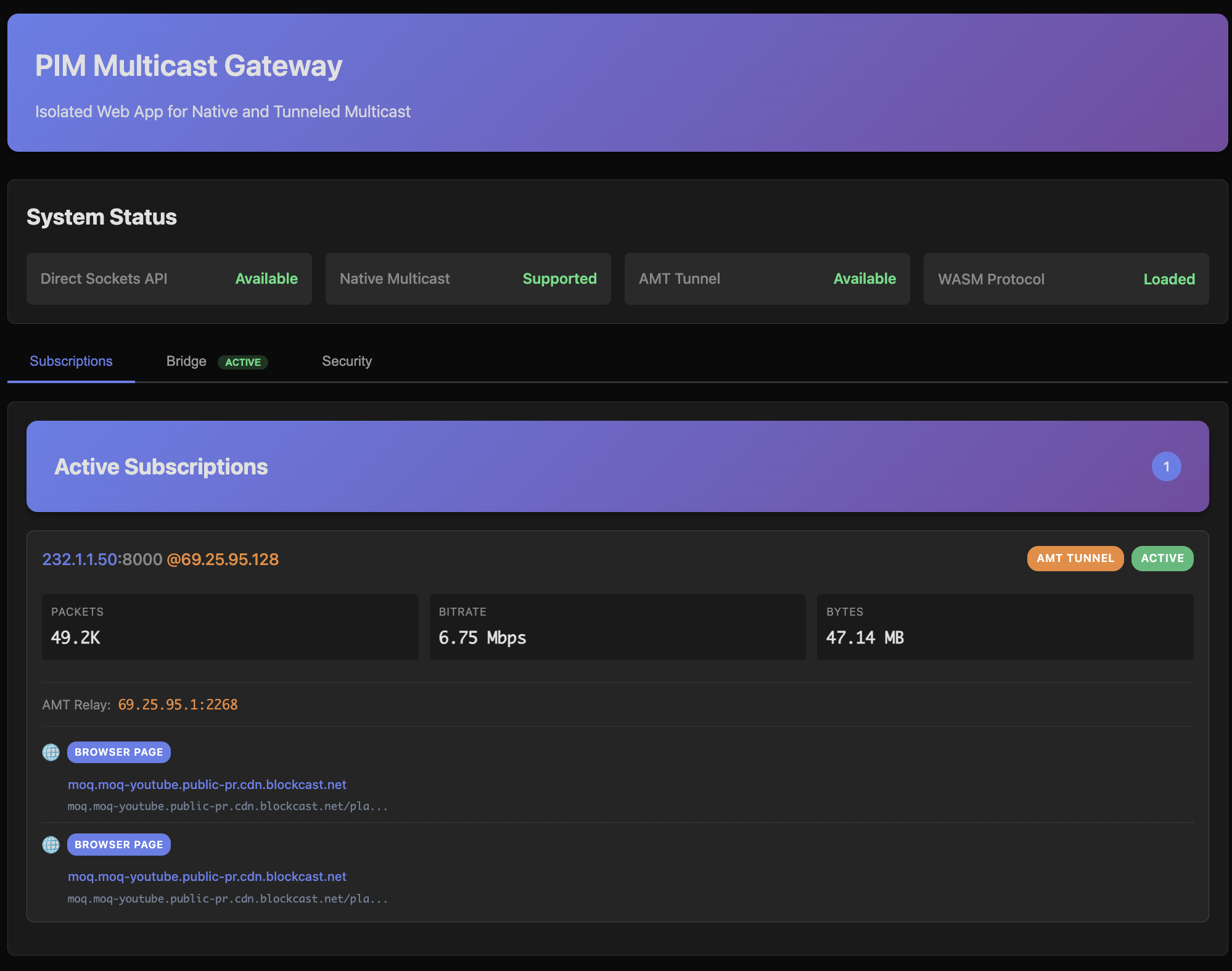
Browser & Mobile The Blockcast Gateway brings native and tunneled multicast directly into web browsers and mobile apps — no plugins, no separate infrastructure. Subscribers receive live multicast streams over direct socket APIs or WASM-based AMT tunnels, with real-time status, packet counters, and bitrate monitoring built in.
The economics of unicast don’t scale. Multicast changes the equation.
Streaming content is delivered via unicast. Every user gets a dedicated bandwidth resource to receive the same stream of bits, even if they are sitting next to each other. This leads to exponential growth in delivery costs — 1 million viewers at 5 Mbps consumes 5 Tbps of backbone bandwidth. But like broadcast, with multicast a single stream of content is delivered to a given geographic area. Any users who want to watch just connect to the stream, significantly reducing delivery costs through commercial networks like ISPs and CDNs.
Streaming relies on tens of thousands of servers (reverse proxies like Varnish and NGINX) at the edge of ISP networks. No matter how powerful, each server supports a finite number of individual connections. Combined with the need for redundancy and geographic spread for fast connection times and low RTTs, the hardware footprint for a large live streaming event is significant. Multicast does away with all that. Players “subscribe” to the stream instead of connecting to a server — less infrastructure, less cost, less to manage.
Built on QUIC, the Blockcast RELAY’s MoQ path provides sub-500ms latency — ideal for real-time use cases like live sports, esports, and interactive experiences.
Every multicast packet is cryptographically signed, preventing injection of forged content into the delivery stream — verified at each node in the distribution tree.
DNS-based discovery finds the topologically nearest Blockcast RELAY automatically. No separate signaling infrastructure needed — discovery is built into the delivery path.
Built-in logging and support for player analytics like CMCD provide detailed stream-level and session-level data for monitoring quality of experience at scale.
Find out more about TreeDN and how it enables MoQCAST to deliver your streaming content multicast over the internet.
Get technical details and diagrams showing how MoQCAST goes from single MMT encode to multi-path multicast delivery.
Learn about the MMT Unified Container and how it makes multicast streaming content possible to browsers, phones, and TVs.
Because MoQCAST is built on MoQ, yes, it requires a MoQ-compatible player. You can get an open-source MoQ player from moqtail.dev or moq.dev. You can also choose to use the MoQCAST Player, which already includes the SDK needed for multicast playback.
Yes. Although a MoQ player can play the QUIC content streamed from MoQCAST, open-source MoQ players are not multicast-enabled. To enable this, you’ll need to install the lightweight MoQCAST Player SDK into your MoQ player. Our MoQ multicast extensions are implemented for moq.dev and moqtail.dev.
The initial format is not important. So long as it’s a format that FFmpeg can ingest, the MoQCAST Packager can package it as MMT for multicast delivery.
The MoQCAST Player or a MoQ player with the MoQCAST extensions always starts as a unicast player. It will “upgrade” to multicast with AMT fallback if native multicast is not available.
MoQ is an initiative of the Internet Engineering Task Force (IETF). There are open-source implementations like MoQ Tail (moqtail.dev) and moq.dev where you can get detailed technical information about this QUIC-based streaming approach.
The ideal use cases for any QUIC-based streaming are those that require real-time content delivery such as betting and interactive experiences. MoQ is also ideal for live sports where sub-500ms latency makes a meaningful difference.
The Blockcast RELAY supports Juniper for hardware AMT relays and Linux 5.14+ for soft relays.
WebRTC requires specialized servers. MoQ can be delivered from standard HTTP reverse proxies, making it scale much better and cheaper than WebRTC. In addition, the media functions being developed as part of the MoQ effort improve the delivery of video using QUIC.

.png)
